Publication Database Search

Request a copy of Publication Summaries
Surgery Types
Document Categories
View All Documents
Surgery Types
Document Categories
Thank you! Your submission has been received!
Oops! Something went wrong while submitting the form.
Tag template
Title
Authors
Year
Read more

The use of intraoperative transit time flow measurement can reduce postoperative myocardial injury

Quan Z et al
2022
Published Articles
Cardiac
The use of intraoperative transit time flow measurement can reduce postoperative myocardial injury

Objectives: This study investigates the relationship between the use of transit time flow measurement (TTFM) and postoperative myocardial injury in off-pump coronary artery bypass grafting (OPCABG).Methods: In this retrospective study, we collected basic data from patients hospitalized for OPCABG in the Department of Cardiothoracic Surgery, Changzhou Second People’s Hospital Affiliated with Nanjing Medical University. According to the academic research consortium (ARC)-2 definition of significant myocardial injury, we used cardiac troponin I >2380 ng/L as a criterion for significant postoperative myocardial injury. We use logistic regression and forest plots to assess the association of TTFM use with myocardial injury outcomes.

Results: Read more...

Authors
Quan Z, Zhang X, Song X, Chen P & Wu Q.

The Use of Intraoperative Transit Time Flow Measurement for Coronary Artery Bypass Surgery - Systematic Review of the Evidence and Expert Opinion Statements

Gaudino M et al
2021
Published Articles
Cardiac
The Use of Intraoperative Transit Time Flow Measurement for Coronary Artery Bypass Surgery - Systematic Review of the Evidence and Expert Opinion Statements

Transit time flow measurement (TTFM) allows quality control in coronary artery bypass grafting but remains largely underused, probably because of limited information and the lack of standardization. We performed a systematic review of the evidence on TTFM and other methods for quality control in coronary artery bypass grafting following PRISMA standards and elaborated expert recommendations by using a structured process. A panel of 19 experts took part in the consensus process using a 3-step modified Delphi method that consisted of 2 rounds of electronic voting and a final face-to-face virtual meeting. Eighty percent agreement was required for acceptance of the statements. A 2-level scale (strong, moderate) was used to grade the statements based on the perceived likelihood of a clinical benefit.

The existing evidence supports an association between TTFM readings and graft patency and postoperative clinical outcomes, although there is high methodological heterogeneity among the published series. The evidence is more robust for arterial, rather than venous, grafts and for grafts to the left anterior descending artery. Although TTFM use increases the duration and the cost of surgery, there are no data to quantify this effect. Based on the systematic review, 10 expert statements for TTFM use in clinical practice were formulated. Six were approved at the first round of voting, 3 at the second round, and 1 at the virtual meeting. Read more...

Authors
Gaudino M, Sandner S, Di Giammarco G, Di Franco A, Arai H, Asai T, Bakaeen F, Doenst T, Fremes SE, Glineur D, Kieser TM, Lawton JS, Lorusso R, Patel N, Puskas JD, Tatoulis J, Taggart DP, Vallely M & Ruel M.

Surgery or Endovascular Therapy for Chronic Limb-Threatening Ischemia

Farber A et al.
2022
Published Articles
Vascular
Surgery or Endovascular Therapy for Chronic Limb-Threatening Ischemia

Background: Patients with chronic limb-threatening ischemia (CLTI) require revascularization to improve limb perfusion and thereby limit the risk of amputation. It is uncertain whether an initial strategy of endovascular therapy or surgical revascularization for CLTI is superior for improving limb outcomes.

Methods: In this international, randomized trial, we enrolled 1830 patients with CLTI and infrainguinal peripheral artery disease in two parallel-cohort trials. Patients who had a single segment of great saphenous vein that could be used for surgery were assigned to cohort 1. Patients who needed an alternative bypass conduit were assigned to cohort 2. The primary outcome was a composite of a major adverse limb event - which was defined as amputation above the ankle or a major limb reintervention (a new bypass graft or graft revision, thrombectomy, or thrombolysis) - or death from any cause.

Results: Read more...

Authors
Farber A, Menard MT, Conte MS, Kaufman JA, Powell RJ, Choudhry NK, Hamza TH, Assmann SF, Creager MA, Cziraky MJ, Dake MD, Jaff MR, Reid D, Siami FS, Sopko G, White CJ, van Over M, Strong MB, Villarreal MF, McKean M, Azene E, Azarbal A, Barleben A, Chew DK, Clavijo LC, Douville Y, Findeiss L, Garg N, Gasper W, Giles KA, Goodney PP, Hawkins BM, Herman CR, Kalish JA, Koopmann MC, Laskowski IA, Mena-Hurtado C, Motaganahalli R, Rowe VL, Schanzer A, Schneider PA, Siracuse JJ, Venermo M, Rosenfield K

The feasibility and applications of non-invasive cardiac output monitoring, thrombo-elastography and transit-time flow measurement in living-related renal transplantation surgery: results of a prospective pilot observational study

2014
Published Articles
Transplantation
The feasibility and applications of non-invasive cardiac output monitoring, thrombo-elastography and transit-time flow measurement in living-related renal transplantation surgery: results of a prospective pilot observational study

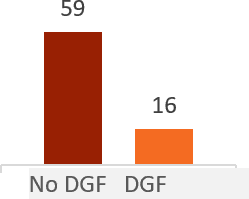
Delayed graft function (DGF) remains a significant and detrimental post-operative phenomenon following living-related renal allograft transplantation, with a published incidence of up to 15%. Early therapeutic vasodilatory interventions have been shown to improve DGF, and modifications to immunosuppressive regimens may subsequently lessen its impact. This pilot study assesses the potential applicability of perioperative non-invasive cardiac output monitoring (NICOM), transit-time flow monitoring (TTFM) of the transplant renal artery and pre-/perioperative thromboelasto-graphy (TEG) in the early prediction of DGF and perioperative complications.
Methods: Ten consecutive living-related renal allograft recipients were studied. Non-invasive cardiac output monitoring commenced immediately following induction of anaesthesia and was maintained throughout the perioperative period. Doppler-based TTFM was performed during natural haemostatic pauses in the transplant surgery: immediately following graft reperfusion and following ureteric implantation. Central venous blood sampling for TEG was performed following induction of anaesthesia and during abdominal closure.
Results: See more...

Authors
Goodyear SJ, Barnes J, Imray CE, Higgins R, Lam FT, Kashi SH, Tan LC & Imray CHE

Target Vessel Detection by Epicardial Ultrasound in Off-Pump Coronary Bypass Surgery

Hayakawa M et al
2013
Published Articles
Cardiac
Target Vessel Detection by Epicardial Ultrasound in Off-Pump Coronary Bypass Surgery

Objectives: The detection of embedded coronary arteries is difficult especially in off-pump coronary bypass surgery. From June 2010, we introduced high-frequency epicardial ultrasound (ECUS) to assess and evaluate embedded arteries during off-pump coronary bypass surgery.

Methods: Between June 2010 and June 2011, a total of 89 consecutive patients underwent isolated coronary bypass surgery at our institution. The patients consisted of 72 men and 17 women with a mean age of 67.9 years. We routinely use the VeriQ CTM system (Medistim, Oslo, Norway) to detect the target vessels in the operation. The patients were assigned to one of two groups, depending on whether ECUS was used in the operation (n = 10, ECUS group) or not (n = 79, non-ECUS group). We analyzed the impact of introducing the ECUS in terms of operative outcome.

Results: Read more...

Authors
Hayakawa M, Asai T, Kinoshita T, Suzuki T & Shiraishi S
Other transplantation
Renal (Kidney)
Liver
Other Vascular
AV Access
Peripheral Bypass
Carotid Endarterectomy
Other Cardiac
Minimally Invasive CABG
CABG