Publication Database Search
Transit-time flow predicts outcomes in coronary artery bypass graft patients: a series of 1000 consecutive arterial grafts
Objective: This study was undertaken to evaluate transit-time flow (TTF) as a tool to detect technical errors in arterial bypass grafts intra-operatively and predict outcomes.
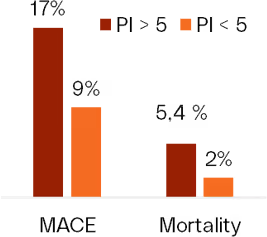
Methods: TTF’s three parameters, pulsatility index (PI, index of resistance), flow (cc min(-1)) and diastolic filling (DF, proportion of diastole with coronary flow), were measured in 990/1000 (99%) of arterial grafts in 336 consecutive patients, prospectively enrolled in a database. Grafts were revised when TTF findings supported the otherwise suspected graft malfunction. If no other signs/suspicion of graft malfunction existed (normal electrocardiogram (EKG), stable haemodynamics and unchanged ventricular function on trans-oesophageal echocardiography (TEE)), and the PI was >5, grafts were not revised. Major adverse cardiac events (MACEs: recurrent angina, perioperative myocardial infarction, postoperative angioplasty, re-operation and/or perioperative death) were related to TTF measurements.
Results: Read more...
Twenty-year experience with off-pump coronary artery bypass grafting and early postoperative angiography
Objective: Background: We have performed off-pump coronary artery bypass grafting (off-pump CABG; OPCAB) and also performed early postoperative angiography to assess anastomosis accuracy and patency in most of our patients requiring surgical revascularization.
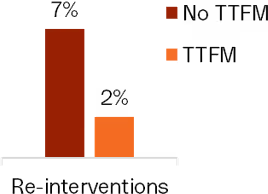
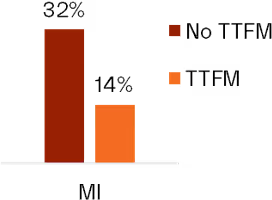
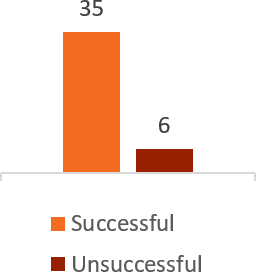
Methods: Of 3083 patients who underwent isolated CABG between 1998 and 2017, 2919 patients (94.7%) underwent OPCAB. Conduits for distal anastomoses were left internal thoracic artery (ITA;n=2764), right ITA (n=866), right gastroepiploic artery (n=997), radial artery (n=16), and saphenous vein (n=1505). Since the introduction of transit-time flow measurement (TTFM) in 2000, we revised abnormal grafts intraoperatively. Early (≤7days) angiography was performed in 2820 patients (96.6%) at 1.5±1.2 postoperative days, and surgical intervention was performed based on angiographic findings.
Results: Read more...
Transit time flow measurement in arterial grafts
Coronary artery bypass grafting (CABG) is one of the foundations of treatment for coronary artery disease. While it has improved substantially since its inception more than 50 years ago, including a rising use of multiple arterial grafting, intraoperative quality assessment is yet to be disseminated as an integral part of the procedure. Read More...
Too Much, Too Little, or Just Right? The Importance of Allograft Portal Flow in Deceased Donor Liver Transplantation
While portal flow (PF) plays an important role in determining graft outcomes in living donor liver transplantation, its impact in deceased donor liver transplantation (DDLT) is unclear. The aim of this study was to investigate the correlations between graft PF and graft outcomes in DDLT.
Methods: We retrospectively investigated 1001 patients who underwent DDLT between January 2007 and June 2017 at our institution. The patients were divided into 3 groups according to hazard ratio for 1-year graft loss at each PF value, which was standardized with graft weight. Graft and recipient outcomes were compared between the groups.
Results: See more...
The International Liver Transplantation Society (ILTS) Living Donor Liver Transplant Recipient Guideline
Abstract: Living donor liver transplantation (LDLT) has been increasingly embraced around the world as an important strategy to address the shortage of deceased donor livers. The aim of this guideline, approved by the International Liver Transplantation Society (ILTS), is to provide a collection of expert opinions, consensus, and best practices surrounding LDLT. Recommendations were developed from an analysis of the National Library of Medicine living donor transplantation indexed literature using the Grading of Recommendations Assessment, Development and Evaluation methodology. Writing was guided by the ILTS Policy on the Development and Use of Practice Guidelines (www.ilts.org). Intended for use by physicians, these recommendations support specific approaches to the diagnostic, therapeutic, and preventive aspects of care of living donor liver transplant recipients. Read more...