Publication Database Search
Intraoperative graft flow measurements during coronary artery bypass surgery predict in-hospital outcomes
Transit-time flowmetry enables immediate intraoperative assessment of blood flow parameters in coronary artery bypass grafts (CABG).
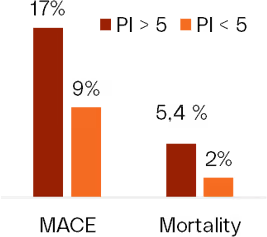
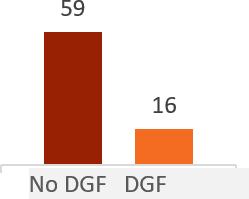
The present study assesses the predictive value of measured graft flows on early and medium-term outcomes. All cardiac surgery patients with measured graft flows were included. The last intraoperative flow measurements recorded using the Medtronic Butterfly Flowmetry system were used for analysis. Patients were separated into two groups: patients with normal flow in all grafts or patients with abnormal flow ≥ 1 graft. Any pulsatility index (pulsatility index=min-max flow/mean flow) ≤ 5 was determined to be normal flow. The study population included 985 patients. Read more...
Intraoperative completion studies and their associations with carotid endarterectomy outcomes
Objective:
This study aimed at assessing outcomes after carotid endarterectomy (CEA) in dependence of center policy with respect to imaging intraoperative completion study (ICSi) usage.
Summary Background Data:
Although randomized controlled studies are missing, a beneficial effect was shown for ICSi techniques (i.e., angiography and intraoperative duplex ultrasound) after CEA.
Methods:
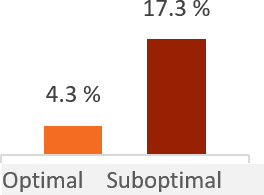
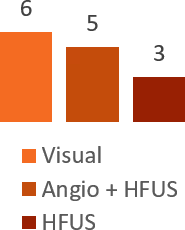
This secondary data analysis is based on the... Read more...
Intraoperative Bypass Flow Measurement Reduces the Incidence of Post-operative Ventricular Fibrillation and Myocardial Markers After Coronary Revascularisation
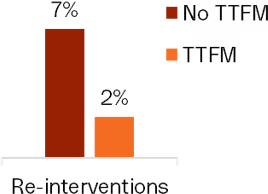
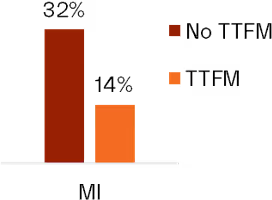
Objective: Sudden ventricular fibrillation (VF) and myocardial infarction (MI) are life-threatening complications after coronary artery bypass grafting (CABG). We prospectively analysed the impact of intraoperative bypass flow measurement with the transit time flow Doppler method (TTFD) on the incidence and outcome of postoperative VF and MI.Methods:In 1995 a standardized algorithm for the treatment of postoperative VF was introduced in our institution. The rate of postoperative VF was therefore exactly registered. In 1998 the TTFD method was implemented as a standard in all CABG cases. Whenever insufficient bypass graft flow was detected, anastomoses were redone and technical problems affecting the grafts were excluded. The incidence of postoperative VF and CK/CK-MB fraction was observed prospectively and the new data was compared to the data from 1995 to 1998.
Results: Read more...
Internal Thoracic Arteries Injuries During Harvesting: Mitigation and Management
Intimal hyperplasia, saphenous vein graft disease, and clinical outcomes: Insights from the CTSN VEST randomized trial
Background: Diffuse intimal hyperplasia and graft irregularity adversely affect the long-term patency of saphenous vein grafts (SVGs) and clinical outcomes of patients undergoing coronary artery bypass grafting (CABG). The VEST trial evaluated the efficacy of external graft support in limiting the development of intimal hyperplasia (IH) at 1 year postsurgery. In the present secondary analysis, we explored the associations between graft disease and IH and clinical events. We also examined risk factors for early graft occlusion.
Methods: VEST is a within-patient randomized, multicenter trial that enrolled 224 patients with multivessel coronary disease undergoing CABG surgery, of whom 203 were evaluated by 1 year postsurgery. Intimal hyperplasia, lumen uniformity, graft stenosis, and graft perfusion were measured by intravascular ultrasound and angiography. Major cardiac and cerebrovascular events (MACCE; including death, myocardial infarction, stroke, and revascularization) were recorded over a median follow-up of 3 years.
Results:... Read more...