Publication Database Search
CIDAC - Prospective comparison of duplex ultrasound and angiography for intra-operative completion studies after carotid endarterectomy
Objective: The application of intra-operative completion studies may have contributed to the ongoing improvement of peri-operative outcomes in carotid surgery.
Methods: This prospective study aimed to compare angiography and duplex ultrasound (IDUS) as intra-operative completion studies after carotid endarterectomy (CEA) with respect to differences in the rating of vessel wall defects and interobserver reliability. Patients undergoing CEA for symptomatic or asymptomatic carotid stenosis were included. After CEA, angiography and IDUS were performed. Intra-operatively obtained video footage was evaluated at a later date by three independent and blinded raters with different levels of clinical experience. Rating was done according to a four step rating scale, with higher grades representing more severe defects. Standard statistical methods (Pearson’s chi square test; permutation test; Wilcoxon signed rank test; Kendall’s coefficient of concordance, Wt) were applied.
Results: Read more...
Comparing perioperative outcomes following off-pump multi-vessel minimally invasive via a single left intercostal space incision with mediansternotomy coronary artery bypass grafting: A single-center retrospective cohort study
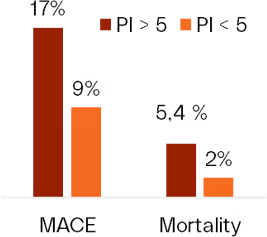
Background: The perioperative outcomes following off-pump multi-vessel minimally invasive surgery (MICS) coronary artery bypass grafting (CABG) via a single left intercostal space incision has not been well evaluated.Methods: From July 2019 to January 2022, a total of 444 patients with multi-vessel coronary artery disease (CAD) were enrolled and divided into MICS (n = 179) and sternotomy CABG (n = 265). Perioperative outcomes were compared between these two groups, including intraoperative blood loss, postoperative first 24 h drainage, ventilation duration, length of stay (LOS) in ICU and total LOS in hospital. Intraoperative blood flow of graft vessels were measured by transit time flow measurement after vascular anastomosis and mean flow (MF) and pulsatile index (PI) were compared.
Results: Read more...
Arterial Blood Flow Predicts Graft Survival in Liver Transplant Patients
Proper liver perfusion is essential for sufficient organ function after liver transplantation. The aim of this study was to determine the effects of portal and arterial blood flow on liver function and organ survival after liver transplantation. The arterial and portal venous blood flow was measured intraoperatively by transit time flow measurement after reperfusion for 290 consecutive liver transplants. The graft survival, hepatic cell damage (alanine aminotransferase and aspartate aminotransferase), and liver function (prothrombin ratio and bilirubin) were determined. Read more...
The 10 Commandments for Proximal Anastomosis During CABG: Techniques and Technologies for Vein and Arterial Grafts
In coronary artery bypass grafting (CABG), the proximal anastomosis and management of the ascending aorta are critical moments that significantly influence the risk of perioperative stroke, due to the potential for cerebral embolization from dislodged aortic debris or hypoperfusion caused by hypotension.Perioperative stroke remains one of the most severe complications of CABG, leading to significant morbidity, mortality, and economic burden.