

Publication Summaries

Database

Medistim Driven

Medistim Supported
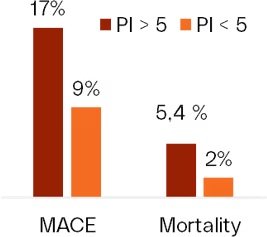
Kieser 2010
3-year post-op follow-up PI< 5 connected to less risk of MACE and death
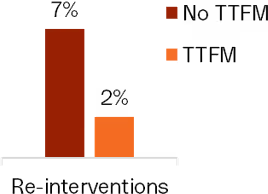
Kim 2019
Less re-interventions with TTFM than without TTFM
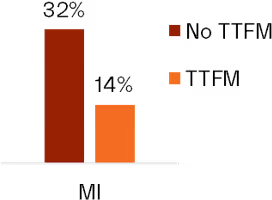
Quan 2022
Less perioperative MI with TTFM than without TTFM
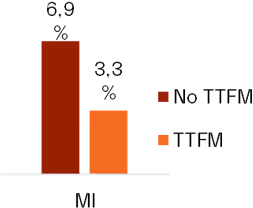
Laali 2022
Add 3 min and reduce MACE by 50%
Circulation 2021
10 consensus statements recommending the use of TTFM in every CABG procedure

Meyer 2019
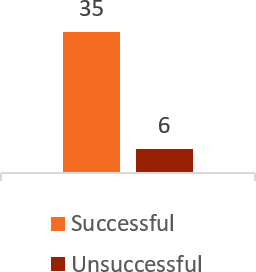
Flow >170mL/min predicts successful maturation of AVF.
Miyake 2019
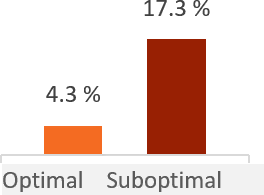
Optimal flow reduces the risk for early graft occlusion after Peripheral Bypass.
Troisi 2025
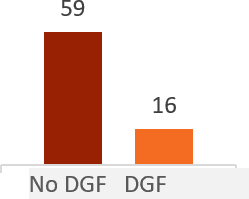
Arterial flow > 310 mL/min reduces risk of delayed graft function after kidney transplantation.
Knappich 2020
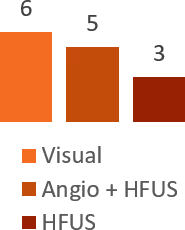
CIDAC: HFUS enables more correct detection of higher-grade defects than angiography during CEA.
Publication Database Search
Thank you! Your submission has been received!
Oops! Something went wrong while submitting the form.
Publication Summaries
Consice insights from key clinical studies - empowering surgeons with evidence that drivers better outcomes
Request your copy:
Oops! Something went wrong while submitting the form.
Medistim Driven Studies
Medistim Supported Studies
CIDAC
Prospective Comparison of Duplex Ultrasound and Angiography for Intra-operative Completion Studies after Carotid Endarterectomy (CIDAC)
Kidney transplant
Prospective assessment of intraoperative renal perfusion with Transit time flow measurments (TTFM) in deceased and living donor kidney transplantation.
SMARTFLOW
Time to Assess the Role of Quality Control in CABG: The SMARTFLOW Trial Program
ROMA women
ROMA: Women: Innovative Approaches for the First Cardiac Surgery Trial in Women


