Publication Database Search
Intraoperative transit-time flow measurement and high-frequency ultrasound in coronary artery bypass grafting: impact in off versus on-pump, arterial versus venous grafting and cardiac territory grafted
Objectives: Despite society guideline recommendations, intraoperative high-frequency ultrasound (HFUS) and transit-time flow measurement (TTFM) use in coronary artery bypass grafting (CABG) has not been widely adopted worldwide. This retrospective review of the REQUEST (REgistry for QUality assESsmenT with Ultrasound Imaging and TTFM in Cardiac Bypass Surgery) study assesses the impact of protocolled high-frequency ultrasound/TTFM use in specific technical circumstances of CABG.
Methods: Three REQUEST study sub-analyses were examined: (i) For off-pump (OPCAB) versus on-pump (ONCAB) procedures: strategy changes from preoperative plans for the aorta, conduits, coronary targets and graft revisions; and for all REQUEST patients, revision rates in: (ii) arterial versus venous grafts; and (iii) grafts to different cardiac territories.
Results: Read more...
Intraoperative Graft Verification in Renal Transplants
The success of an arterial reconstruction is dependent on multiple factors, including patient selection, quality of the vessels, type of vascular conduit employed, and the surgical technique adopted. Transit time flow measurement is a technique that is now the standard of care for immediate graft patency verification following coronary artery bypass graft surgery. Read more...
Intraoperative measurement of graft blood flow - a necessity in liver transplantation
Portal venous and hepatic arterial flow was measured intraoperatively in the 70 most recent patients undergoing liver transplantation in our institution. Impaired graft flow due to vascular abnormalities was detected in six patients. Read more…
Intraoperative graft verification in coronary surgery
Transit-time flow measurement (TTFM) is a reliable method to check the graft function intraoperatively in coronary surgery. The given parameters are Mean Graft Flow (MGF); Pulsatility Index (PI) and Insufficiency Ratio (%BF).
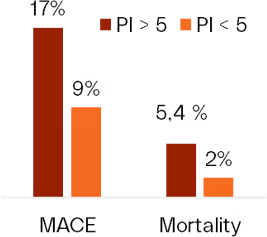
Some cutoffs of these parameters have been identified as predictors for unfair 1-y clinical outcome: mean graft flow (MGF) less than 20 ml/min and high pulsatility index greater than 5.
Other cutoffs have been found as related to postoperative angiography: MGF 15 ml/min or less and pulsatility index at least 3 (sensitivity 94%; specificity 61%); MGF less than 15 ml/min and pulsatility index greater than 3 for left coronary artery.
Pulsatility index greater than 5 for right coronary artery (sensitivity 96%; specificity 77%); MGF 15 ml/min or less and pulsatility index at least 5.1 left coronary artery (sensitivity 98%; specificity 26%).
Read more...
Intraoperative transit-time flow measurement and high-frequency ultrasound assessment in coronary artery bypass grafting - REQUEST
Objectives: We evaluated the influence of transit-time flow measurement with epicardial and epiaortic high-frequency ultrasound in patients undergoing coronary artery bypass grafting procedure. Methods: The Registry for Quality Assessment with Ultrasound Imaging and Transit-time Flow Measurement in Cardiac Bypass Surgery study is a multicenter, prospective study among 7 international centers performing coronary artery bypass grafting procedures. The primary end point was any change in the planned surgical procedure. Major secondary end points consisted of the rate and reason for surgical changes related to the aorta, in situ conduits, coronary targets, and completed grafts, and the rate of in-hospital mortality and major morbidity.
Results: Read more...