Publication Database Search

Request a copy of Publication Summaries
Surgery Types
Document Categories
View All Documents
Surgery Types
Document Categories
Thank you! Your submission has been received!
Oops! Something went wrong while submitting the form.
Tag template
Title
Authors
Year
Read more

Global vascular guidelines on the management of chronic limb-threatening ischemia

Conte MS et al.
2019
Guidelines
Vascular
Global vascular guidelines on the management of chronic limb-threatening ischemia
Authors
Conte MS, Bradbury AW, Kolh P, White JV, Dick F, Fitridge R, Mills JL, Ricco JB, Suresh KR, Murad MH

Graft flow predictive equation in distal bypass grafting for critical limb ischemia

Miyake K et al.
2019
Published Articles
Vascular
Graft flow predictive equation in distal bypass grafting for critical limb ischemia

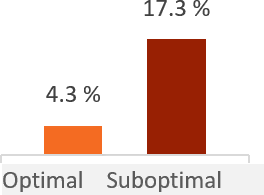
Objective: Graft flow (GF) seems to be an important prognostic predictor in distal bypass for critical limb ischemia, but previous studies have failed to clarify the association between GF and the graft prognosis. GF differs significantly among grafts, and each graft seems to have an optimal GF depending on various factors. We hypothesized that comparison between the measured GF (mGF) and optimal estimated GF (eGF) would be important in predicting graft prognosis. Herein, we aimed to develop a GF predictive equation by assessing GF determinants and to validate the equation against a clinical dataset.

Methods: A total of 198 distal bypasses with vein grafts for critical limb ischemia from 2011 to 2016 were enrolled. Of these grafts, 135 normal grafts without any abnormalities on early postoperative ultrasound examination were used to develop and validate the equation. Various anatomic and patient-related factors were analyzed to detect GF determinants with stepwise selection, and the GF predictive equation was developed with multiple linear regression analysis. After developing the equation, all 198 grafts were categorized into two groups according to the equation developed based on data from the 135 normal grafts as follows: optimal flow grafts (OFGs), in which mGF > eGF - 14.6, and suboptimal flow grafts (SFGs), in which mGF < eGF - 14.6. The cutoff value of 14.6 was determined using receiver operating characteristic curves to detect graft abnormalities. By comparing OFGs and SFGs, the efficacy of the equation in predicting bypass abnormalities and graft prognosis was assessed.

Results: Read more...

Authors
Miyake K, Kikuchi S, Okuda H, Koya A, Sawa Y & Azuma N

EAU Guidelines on Renal Transplantation

Breda A et al.
2021
Guidelines
Transplantation
EAU Guidelines on Renal Transplantation

This guideline includes recommendations regarding diagnosis of thrombosis and stenosis in kidney recipients. Read more…

Authors
Breda A, K. Budde K, Figueiredo KA, Lledó García E, Olsburgh J, Regele H

Determinants of successful arteriovenous fistulae creation including intraoperative transit time flow measurement

Meyer A et al.
2019
Published Articles
Vascular
Determinants of successful arteriovenous fistulae creation including intraoperative transit time flow measurement

Background: The prevalence of hemodialysis patients is increasing, and it is important to create the arteriovenous fistula as early as possible to avoid hemodialysis by central venous catheter. International guidelines recommend arteriovenous fistula as the vascular access of first choice. Arteriovenous fistulae are associated with a failure rate of 23%. The success of an arteriovenous fistula can be evaluated intraoperatively by physical examination and by measuring the blood flow.

Objectives: The aim of the study is to describe the predictive value of various factors for fistula maturation in the context to the current literature.

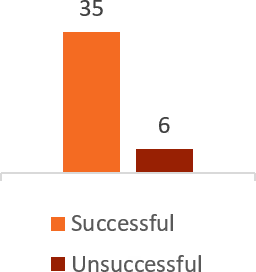
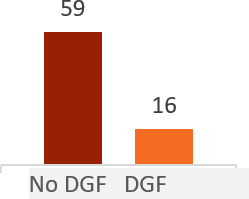
Methods: We report on a prospective cohort study of 41 patients, undergoing a primary arteriovenous fistula at the upper extremity. The primary endpoint of the study was the successful fistula maturation after 6 weeks.

Results: Read more...

Authors
Meyer A, Flicker E, König ST and Vetter AS

Detection of Internal Thoracic Artery Dissection at Coronary Anastomosis Using Intraoperative 15-MHz High-Frequency Epicardial Ultrasound

Watanabe T et al
2014
Published Articles
Cardiac
Detection of Internal Thoracic Artery Dissection at Coronary Anastomosis Using Intraoperative 15-MHz High-Frequency Epicardial Ultrasound

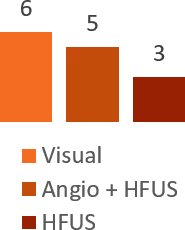
This case report is based on the observations of a 66 year old man with 3 vessel disease who underwent off-pump coronary artery bypass grafting including a LIMA-LAD procedure. Routinely use of TTFM showed flow 10 ml/min, pulsatility index of 2, diastolic filling of 65% and an acceptable flow curve. The flow measurement was lower than expected and epicardial imaging was done by using a 15-Mhz high frequency ultrasound probe. Read more...

Authors
Watanabe T, Arai H, Oi K, Hachimaru T, Kuroki H, Fujiwara T & Mizuno T
Other transplantation
Renal (Kidney)
Liver
Other Vascular
AV Access
Peripheral Bypass
Carotid Endarterectomy
Other Cardiac
Minimally Invasive CABG
CABG